Selasa, 24 Desember 2019

The 9 Best Blobs of 2019 - Livescience.com

[unable to retrieve full-text content]

The 9 Best Blobs of 2019  Livescience.com
https://news.google.com/__i/rss/rd/articles/CBMiM2h0dHBzOi8vd3d3LmxpdmVzY2llbmNlLmNvbS9iZXN0LWJsb2JzLW9mLTIwMTkuaHRtbNIBAA?oc=5

2019-12-24 12:00:00Z
CBMiM2h0dHBzOi8vd3d3LmxpdmVzY2llbmNlLmNvbS9iZXN0LWJsb2JzLW9mLTIwMTkuaHRtbNIBAA

Steamboat Geyser Keeps Erupting And Keeps Baffling Scientists - NPR

Steamboat Geyser at Yellowstone National Park on Sept. 17, 2018. Jacob W. Frank/NPS hide caption

toggle caption
Jacob W. Frank/NPS

Steamboat Geyser, the tallest active geyser in the world, erupted more times in 2019 than in any other year, baffling scientists who are trying to understand what triggered this unusual streak of activity.

The geyser can shoot water more than 300 feet into the air, and this year it erupted more than 45 times, surpassing the 32 eruptions recorded in 2018.

In the three years before that, however, the geyser didn't erupt at all. Unlike Old Faithful, which is famous for its highly predictable eruptions, Steamboat is an erratic giant.

"In the 1960s, there was another period where there were more than 20 eruptions per year," says Erin White, Yellowstone National Park's hydrologist. "Prior to that, there were dormant periods of more than 50 years."

She's stood right next to Steamboat as it was venting steam. "It is incredibly powerful," White says. "It's like standing next to a jet engine."

Steamboat's reawakening is an opportunity for researchers to try to answer some fundamental questions about how geysers work.

"It's such a big geyser. And the bigger something is, the easier it is to study," says Michael Manga of the University of California, Berkeley. "But it also captures people's imagination. When it got active again there was lots of press and it reminded people that there are fundamental things about the Earth we don't understand."

Geysers are relatively rare — the planet has fewer than 1,000, and about half of them are in Yellowstone.

And not many people study these erupting hot springs. The geyser scientific community "is a community of almost nobody," Manga says.

A couple years ago, when he and a colleague wrote a review of geyser research for a science journal, "we could cite just about every paper ever written about geysers. And there's very few fields where you can do that."

Researchers do know the basic ingredients needed for a geyser, White says.

"You need to have a source of water, you need a source of heat, and you need a structure, a geologic structure, that is constrained or confined in some way to develop pressure that will generate an eruption," she says.

Yellowstone is a seismically active place, and it's possible that the reactivation of Steamboat was somehow related to the Maple Creek earthquake swarm in 2017, says Yellowstone National Park geologist Jeff Hungerford.

"Steamboat is in the Norris geyser basin, and the Norris geyser basin is a really dynamic area. It's one of the hottest areas of the park and it's also one area in the park where we see focused deformation, or swelling of the ground, where the ground actually uplifts and subsides," Hungerford says.

All of that might have created channels for fluids to move around underground. But researchers do not have detailed maps of what's going on beneath Steamboat.

"What is the subsurface architecture?" White wonders. "What is the volume of water that is available for every eruption?"

"People always ask, 'Well, why is steamboat such a tall geyser?' We can't answer that question," Manga adds.

Scientists do have temperature sensors deployed around the geyser. And there's been recent studies using arrays of seismic sensors. It appears that Steamboat's liquid is stored at depths of about 65 to 130 feet, Manga says.

"The deeper water is stored, the warmer it will be. That heat provides the energy that drives the eruption," Manga says.

"At other geysers, that storage seems to be more shallow," he explains. "And our hypothesis for the reason why Steamboat is such a huge geyser and so tall is that the water is stored deeper. The deeper the water is stored, the more energy it can have. And the more energy you have, the bigger the eruption can be."

Some of the first studies of geysers were done back in the 1800's, by Robert Bunsen — the same guy who developed the Bunsen burner used in chemistry classes. Scientists have put video cameras in geysers, and built artificial geysers in the lab.

Still, it's not so easy to find funding to study something like geysers and the list of unanswered questions goes on and on, Manga says.

He rattles off a list: "Why do geysers exist in the first place? What is it about the geometry that makes something become episodic? Why do eruptions end? Why don't they just continue? How do geysers respond to external forces? What controls how high a geyser eruption is?"

Millions of people travel to see geysers each year, and part of the draw may be their air of mystery. Steamboat has become a superstar, eclipsing even Old Faithful in terms of public attention and the effort people make to try to catch an eruption.

"There are people that camp on the sidewalks, spend all of their days, all of their time off, sitting next to Steamboat," White says.

Let's block ads! (Why?)


https://news.google.com/__i/rss/rd/articles/CBMidGh0dHBzOi8vd3d3Lm5wci5vcmcvMjAxOS8xMi8yNC83ODY3MTY3Mzkvc3RlYW0tb24tc3RlYW1ib2F0LXRoZS13b3JsZHMtdGFsbGVzdC1hY3RpdmUtZ2V5c2VyLWhhcy1hbm90aGVyLXJlY29yZC15ZWFy0gEA?oc=5

2019-12-24 10:05:00Z
CAIiEJmqvmHd3vsIhZrZvUw61L4qFggEKg4IACoGCAow9vBNMK3UCDCvpUk

Incredible photo shows an astronaut celebrating Hanukkah from space - Business Insider

  • NASA astronaut Jessica Meir posted an incredible Hanukkah greeting from the 250 miles above Earth to social media on Sunday.
  • Her Instagram and Twitter posts featured Meir wearing festive socks inside the International Space Station overlooking the planet.
  • „Happy Hanukkah to all those who celebrate it on Earth!“ she wrote in a caption alongside the picture.
  • The photos have garnered tens of thousands of likes and comments from social media users also celebrating the eight-day Jewish festival of lights.
  • Visit Business Insider’s homepage for more stories.

NASA astronaut Jessica Meir posted an incredible Hanukkah greeting from the 250 miles above Earth.

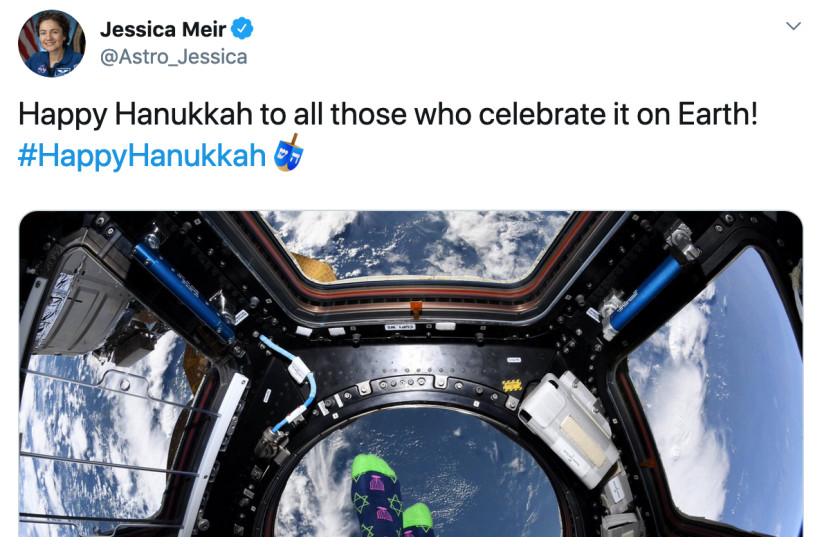
Meir, who is of Swedish-Israeli descent and grew up in the US, posted the awe-inspiring photo to Instagram and Twitter on the first night of Hanukkah, featuring a pair of holiday-themed socks which had Hanukkah emblems including the hanukkiah (candelabra) and the Star of David.

Her festive footwear is seen from inside the International Space Station, where she is currently working aboard as part of NASA’s Expedition 61 and 62. The space station orbits Earth from 250 miles above.

„Happy Hanukkah to all those who celebrate it on Earth!“ she wrote in a caption alongside the picture.

Meir, who also posted the photo to Twitter, has received tens of thousands of likes and comments from people around the world also celebrating the eight-day Jewish festival of lights.

The International Space Station followed up on Twitter with a season’s greeting featuring Meir and her fellow astronauts Christina Koch, Drew Morgan, and Commander Luca Parmitano, who are all spending the holidays apart from their families.

„As a child growing up, I was fortunate enough to celebrate two different holidays all through the holiday season, both Christmas and Hanukkah,“ she said in the video message.

„So whatever it is you’re celebrating this holiday season, we hope that you find peace and love, and enjoy spending time with those around you who are important.“

Meir and Koch conducted the first-female spacewalk in October, spending hours outside the International Space Station to fix a faulty battery part. It was Meir’s first spacewalk and Koch’s fourth.

According to Business Insider’s Morgan McFall-Johnsen, spacewalks, formally called extravehicular activities or EVAs, are routine yet risky operations. During these tasks, the astronauts put on bulky spacesuits and step outside the ISS.

The ISS has conducted 220 spacewalks since its construction in December 1998.

Let's block ads! (Why?)


https://news.google.com/__i/rss/rd/articles/CBMiY2h0dHBzOi8vd3d3LmJ1c2luZXNzaW5zaWRlci5jb20vcGhvdG8tYXN0cm9uYXV0LWplc3NpY2EtbWVpci1jZWxlYnJhdGVzLWhhbnVra2FoLWZyb20tc3BhY2UtMjAxOS0xMtIBY2h0dHBzOi8vYW1wLmJ1c2luZXNzaW5zaWRlci5jb20vcGhvdG8tYXN0cm9uYXV0LWplc3NpY2EtbWVpci1jZWxlYnJhdGVzLWhhbnVra2FoLWZyb20tc3BhY2UtMjAxOS0xMg?oc=5

2019-12-24 03:41:19Z
CAIiEFO1FRJ_77XhElMER7D9qN4qLggEKiUIACIbd3d3LmJ1c2luZXNzaW5zaWRlci5jb20vc2FpKgQICjAMMNfv5wE

Senin, 23 Desember 2019

Starliner: Boeing, Boeing... it's back! Borked capsule makes a successful return to Earth - The Register

Making lemonade out of lemons with Calypso

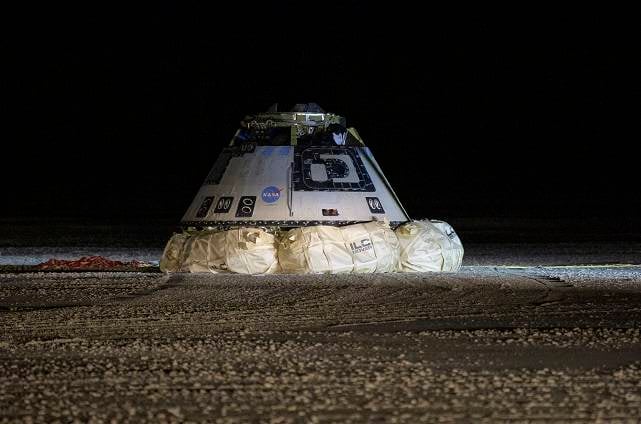
Boeing's borked capsule, the CST-100 Starliner, successfully returned to Earth yesterday while engineers scrambled to work out what went wrong, and managers rushed to justify the truncated mission.

The capsule triumphantly, and finally, left the Earth on Friday morning atop an Atlas V. However, things went badly wrong for the cone-shaped spacecraft after just over 30 minutes, following separation from Centaur second stage. A borked Mission Elapsed Timer meant the spacecraft thought it was further ahead in the mission than it actually was, and Starliner burnt through its attitude control fuel before getting anywhere near the International Space Station (ISS).

In a briefing following the landing, Boeing's Jim Chilton revealed just how far out of whack the clock had got - 11 hours. Exactly how this happened remains unclear at this early stage; the clock is set from data slurped from the Atlas V ahead of lift-off, but in this instance Starliner grabbed the wrong information, something not picked up by horrified techs until it was too late.

Of course, had the mission gone to plan, the CST-100 Starliner would not have spent a huge amount of time alone in orbit anyway. Once docked with the ISS, the plan had called for the capsule to be mostly powered down until it was time to return to Earth.

That docking never happened, meaning (even to the layman) the Starliner did not achieve all the goals of the Orbital Flight Test mission. In the briefing, Chilton said he reckoned that the team were in the "low 60s" in terms of percentage of mission goals at first glance. However, he went on to say, once all the data had been retrieved following the capsule's return to Florida "we're probably in the 85 to 90 per cent range of our test objectives."

Impressive, seeing as the ISS wasn't troubled by the presence of Boeing's baby.

Chilton also called out how pristine the capsule looked following its 1258 UTC landing at White Sands in New Mexico on 22 December. Unlike the SpaceX Dragon capsule, the Starliner comes back to dry land, with airbags cushioning the capsule's impact. Also unlike SpaceX's scorched capsule, the Starliner also appeared remarkably unscathed by re-entry, much like the Space Shuttle of old.

Former Space Shuttle Program Manager, Wayne Hale, observed that the landing occurred on the same runway as STS-3, back in March 1982.

Dubbed Calypso by astronaut Suni Williams (after the Jacques Cousteau ship rather than the lemon-based drink), Boeing and NASA were tight-lipped on when the capsule would fly again with a crew onboard (including Williams.)

Should the agency decide that it really needs to see that capsule do a docking before shoving humans into it, Chilton reckoned that it would likely take a minimum of "three months" to turn things around.

Boeing will, however, take solace from NASA boss Jim Bridenstine, who rounded out the post-landing briefing with "we have a solid understanding of the challenge that we had and why it occurred, and it's not something that is going to prevent us from moving forward quickly."

If NASA and Boeing elect to proceed as planned, the just-landed capsule will host the first crewed mission to the ISS from US soil (following the retirement of the Space Shuttle) in 2020. ®

Sponsored: M3 - The ML, AL and Analytics Conference from The Register

Let's block ads! (Why?)


https://news.google.com/__i/rss/rd/articles/CBMiN2h0dHBzOi8vd3d3LnRoZXJlZ2lzdGVyLmNvLnVrLzIwMTkvMTIvMjMvY3N0XzEwMF9sYW5kcy_SATtodHRwczovL3d3dy50aGVyZWdpc3Rlci5jby51ay9BTVAvMjAxOS8xMi8yMy9jc3RfMTAwX2xhbmRzLw?oc=5

2019-12-23 12:00:00Z
CBMiN2h0dHBzOi8vd3d3LnRoZXJlZ2lzdGVyLmNvLnVrLzIwMTkvMTIvMjMvY3N0XzEwMF9sYW5kcy_SATtodHRwczovL3d3dy50aGVyZWdpc3Rlci5jby51ay9BTVAvMjAxOS8xMi8yMy9jc3RfMTAwX2xhbmRzLw

10 Things We Learned About the Brain in 2019 - Livescience.com

[unable to retrieve full-text content]

10 Things We Learned About the Brain in 2019  Livescience.com
https://news.google.com/__i/rss/rd/articles/CBMiNGh0dHBzOi8vd3d3LmxpdmVzY2llbmNlLmNvbS9icmFpbi1maW5kaW5ncy0yMDE5Lmh0bWzSAThodHRwczovL3d3dy5saXZlc2NpZW5jZS5jb20vYW1wL2JyYWluLWZpbmRpbmdzLTIwMTkuaHRtbA?oc=5

2019-12-23 13:00:00Z
CBMiNGh0dHBzOi8vd3d3LmxpdmVzY2llbmNlLmNvbS9icmFpbi1maW5kaW5ncy0yMDE5Lmh0bWzSAThodHRwczovL3d3dy5saXZlc2NpZW5jZS5jb20vYW1wL2JyYWluLWZpbmRpbmdzLTIwMTkuaHRtbA

The coolest LEGO in the universe - Phys.org

The coolest LEGO ® in the universe
From left: Josh Chawner and Dmitry Zmeev with the LEGO. Credit: Lancaster University

For the first time, LEGO has been cooled to the lowest temperature possible in an experiment which reveals a new use for the popular toy.

Its special properties mean it could be useful in the development of quantum computing.

A world leading team of ultra-low temperature physicists at Lancaster University decided to place a LEGO figure and four LEGO blocks inside their record-breaking dilution refrigerator.

This machine—specially made at the University—is the most effective refrigerator in the world, capable of reaching 1.6 millidegrees above absolute zero (minus 273.15 Centigrade), which is about 200,000 times colder than and 2,000 times colder than .

The results—published in the prestigious journal Scientific Reports—were surprising.

Dr. Dmitry Zmeev, who led the research team, said: "Our results are significant because we found that the clamping arrangement between the LEGO blocks causes the LEGO structures to behave as an extremely good thermal insulator at cryogenic temperatures."

"This is very desirable for used for the design of future scientific equipment like dilution refrigerators."

For the first time, LEGO has been cooled to the lowest temperature possible in an experiment which reveals a new use for the popular toy. Credit: Josh Chawner

Invented 50 years ago, the is at the centre of a global multi-billion dollar industry and is crucial to the work of modern experimental physics and engineering, including the development of quantum computers.

The use of ABS plastic structures, such as LEGO , instead of the currently in use, means that any future thermal insulator could be produced at a significantly reduced cost.

Researchers say the next step is to design and 3-D print a new thermal insulator for the next generation of dilution refrigerators.


Explore further

Quantum computing: Testing qubits has been put in a faster lane

More information: Scientific Reports (2019). DOI: 10.1038/s41598-019-55616-7

Citation: The coolest LEGO in the universe (2019, December 23) retrieved 23 December 2019 from https://phys.org/news/2019-12-coolest-lego-universe.html

This document is subject to copyright. Apart from any fair dealing for the purpose of private study or research, no part may be reproduced without the written permission. The content is provided for information purposes only.

Let's block ads! (Why?)


https://news.google.com/__i/rss/rd/articles/CBMiOGh0dHBzOi8vcGh5cy5vcmcvbmV3cy8yMDE5LTEyLWNvb2xlc3QtbGVnby11bml2ZXJzZS5odG1s0gE3aHR0cHM6Ly9waHlzLm9yZy9uZXdzLzIwMTktMTItY29vbGVzdC1sZWdvLXVuaXZlcnNlLmFtcA?oc=5

2019-12-23 10:00:15Z
52780516106608

‘Happy Hanukkah from space,’ Jewish astronaut says wearing menorah socks - The Jerusalem Post

Since the holiday kicked off on Sunday, Hanukkah wishes and pictures are flooding social media, including many messages from international leaders and celebrities from all over the world. However, an exceptional Hanukkah greeting was even able to transcend the Earth’s borders.“Happy Hanukkah to all those who celebrate it on Earth!” astronaut Jessica Meir tweeted straight from the International Space Station.
Meir, the daughter of an Israeli doctor who moved to Sweden and later to the US, joined the crew of the ISS in September. Two weeks later she participated in the very first all-female spacewalk.As lighting candles every night is the core tradition of the festival, Hanukkah offers plenty of opportunities for evocative pictures and compelling posts on social media (every possible variation of the theme “a light in the dark” gets explored). But lighting fires in outer space can be especially challenging, considering that flames can react to the absence of gravity in an uncontrolled manner. Perhaps for this reason, for her messageMeir opted for a picture of her feet wrapped in a pair of entertaining socks featuring pink menorahs and green stars of David on a blue background. And she did follow the tradition of placing the menorah close to the window, since behind her feet, the earth is visible thousands of kilometers away. One question stands: did Meir bring the designed socks from the earth when she left several months ago or did she get them delivered to space with one of the regular shipments to the ISS?  The bottom line is: it’s never too early to get ready for the holidays.

Let's block ads! (Why?)


https://news.google.com/__i/rss/rd/articles/CBMiamh0dHBzOi8vd3d3Lmpwb3N0LmNvbS9qdWRhaXNtL0hhcHB5LUhhbnVra2FoLWZyb20tc3BhY2UtSmV3aXNoLWFzdHJvbmF1dC1zYXlzLXdlYXJpbmctbWVub3JhaC1zb2Nrcy02MTE4NDPSAWxodHRwczovL20uanBvc3QuY29tL2p1ZGFpc20vSGFwcHktSGFudWtrYWgtZnJvbS1zcGFjZS1KZXdpc2gtYXN0cm9uYXV0LXNheXMtd2VhcmluZy1tZW5vcmFoLXNvY2tzLTYxMTg0My9hbXA?oc=5

2019-12-23 09:22:00Z
CAIiEP1kWorwINWY-Zz1LbFJQkkqGAgEKg8IACoHCAowr9eeCTDYlm4whdicAQ